


Wealth Strategies
From "Healthspans" To Blockchain – A Report From Apex Invest Europe Conference

This news service joined delegates at a two-day conference in Zurich in late October to hear about takes on AI's financial prospects, digital assets, private market investing, the strategies of family offices, changes in Bermuda, and a US ambassador's views about Europe.
The investment case for “healthspans,” AI, real estate, defence and digital assets jostled for attention with other topics as delegates and speakers gathered in late October for the Apex Invest Europe 2026 conference, held in Zurich.
The two-day event, organised by Bermuda-headquartered Apex Group, took place prior to last week’s US mid-term elections and the Binance hacking episodes, to give just two examples of major news events that have seized attention since.
Delegates, representing UHNW private investors, family offices, investment houses and other interested parties sought to get a deeper understanding on how technology, demography, health trends, macro-economics and politics create challenges and opportunities.
WealthBriefing attended the event, held at Dolder Grand (pictured) and was struck by the opening commentary from Alexander Ineichen, an economist, author and founder of his eponymous firm, Ineichen Research and Management AG.
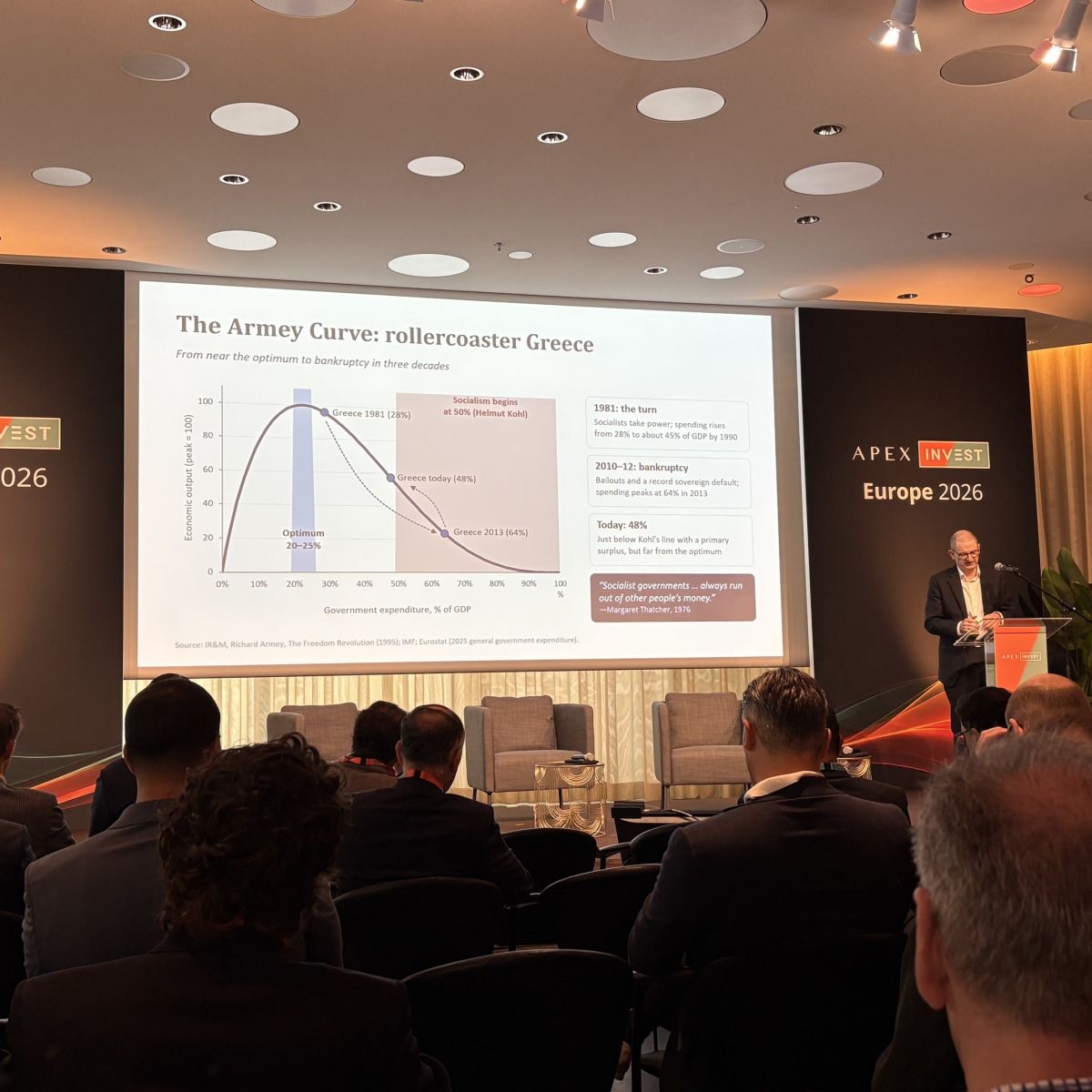
Opening presentation, with Alexander Ineichen to the right.
Ineichen argued that parts of Europe, contrasting with other regions, suffer relatively sluggish growth because governments take increasingly large chunks of GDP. On the basis that a state that takes over half of GDP is a socialist one, France, at 58 per cent, is already there, he said.
Ineichen also did not hold back in contrasting the relatively high price of energy in Europe with that of North America and Asia. UK energy, measured in cents per kilowatt hour, are about three times those of the US, giving the latter a major competitive advantage, he said.
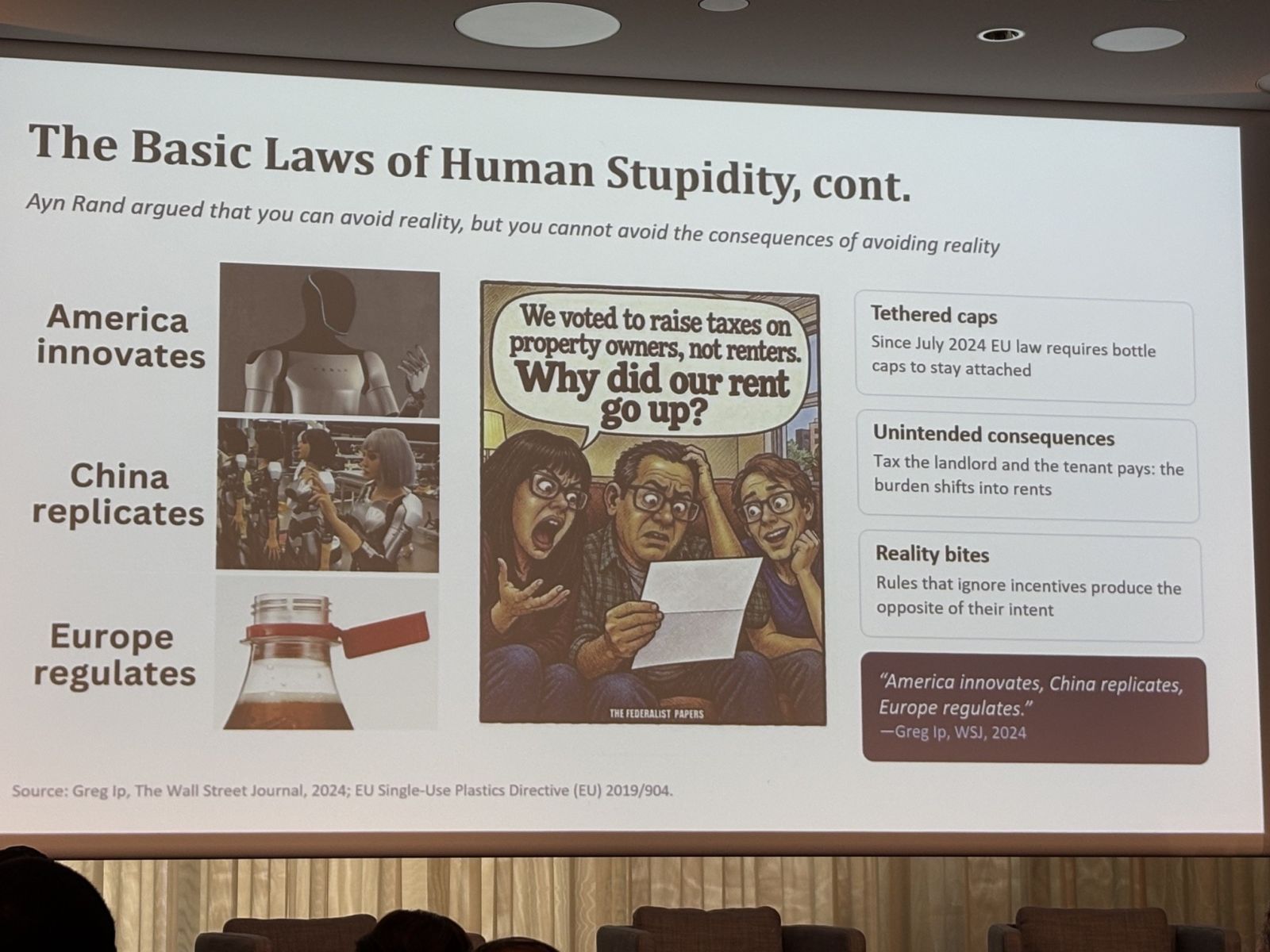
A drive towards higher public spending and regulating certain economic activities has increased the misallocation of capital in affected countries, Ineichen said.
Ineichen was then joined by Christiane El Habre, global head of family offices, regional managing director Middle East, Apex Group; Giovanni Martinez, Novum Partners; Thomas von Hohenhau, head of advisory board, 1911 Capital Management; and David Parker, head of Business Development, Bermuda Business Development Agency.
Martinez said that in Europe, it is possible to buy into certain sectors at lower multiples. Investors are also looking at jurisdiction risks, he said. “Our portfolio is mostly on the late-stage side…we tend to avoid early-stage [investment],” he said.
It is very difficult to know when or what the exact trigger would be for something akin to the eurozone crisis of around 2013, Ineichen said, responding to a question. When former ECB head Mario Draghi gave his “whatever it takes” remarks about supporting the eurozone, this was “almost a random event which actually worked.”
The timing of what central banks or bodies such as the IMF might do if there are further major stresses on the eurozone is “anyone’s guess," he added.
Von Hohenhau said there appears to be a divide between the “risk-on” camp of investors who invest in sectors such as AI, and another, more pessimistic camp expecting a challenging financial climate, looking at areas such as gold.
“Both [sides] make the same macro-economic bet but on the different sides of the same coin,” von Hohenhau said.
Asked about risks, including geopolitics, Parker referred to developments in the Middle East. “We have seen families in the Gulf reviewing their global footprint…but they are not necessarily moving from the Gulf,” he said. People are managing risk by spreading investment around, for example in Hong Kong, Singapore, Switzerland and other centres, he said.
Other panels
The world of private credit came under the spotlight, as
panellists reflected on what has been a varied year for the
sector.
Panel members were Karl Salemangi, global head of sales, Apex Group; Omer Husain, CEO, Pogun; Jürg Niederberger, founder, Q Partners Limited; Michael Manning, head of institutional finance, Avalanche; and Jason Sydney, principal, Saurastar Capital Family Office.
Niederberger said in Europe there are opportunities for risk-adjusted returns in middle-market transactions and these can “work very well.” Sydney said: “we are a family office and can move relatively quickly. We can be quite creative in the structures, demand higher yield and demand additional upside equity.”
Manning talked about private credit and asset-backed lending being well suited to the “rails” of blockchain technology. It can help private credit to be a more robust and widely accepted asset class, he said.
The panel was asked about the redemption run from private credit funds earlier in the year and issues around funds imposing gates.
“People need to read the terms [of funds] again,” Niederberger said. “It [new technology] does not alter what private credit is all about, which is good risk-adjusted returns,” he said.
Manning noted that blockchain tech can help to enable market liquidity, but that is not the same as creating it.
Here are the other panels and discussions:
Anthony Bassili, president of Coinbase Asset Management, delivered a keynote under the title of “Where does bitcoin belong in a modern portfolio?"
A mid-morning panel was held on topics of AI, biotech, and data centre opportunities, and featured comments from Bhaskar Dasgupta, chairman, Global Fundrock Board, and head of regions distribution for Apex Group; Roman Poole, director of sales, Switzerland and Middle East at VanEck; Lux Alvarez, founding general partner, Hiro Capital; Fund Manager, Julius Baer; and Adina Krausz, CEO and founding partner, InnoSource Ventures.
Attention turned to property with a panel under the tag of "Building The Real Estate Portfolio of the Future" with Natalia Michael, co-founder, Banyan Family Office; Alexandra Ammann, senior portfolio manager, Diamond Capital Management (Switzerland); Steve Michael, principal, Banyan Family Office; and Benjamin Habbel, co-founder and CEO, Limestone Capital.
The focus shifted to precious metals with a panel under the heading of "From Gold to Digital Gold: The New Era of Real-World Assets." Panellists were Sean Stapley, partner at Penrose Partners; Tiziana Micallet, deputy head of MFSA; Richard Briffod, chief business officer at DGLD; Beat Rohner, portfolio manager, Private Investor; and Jill Friedman, COO of Symbiotic.
Let’s get healthier
Health was on the menu in a panel entitled the "Healthspan
Economy: Investing in Longer, Healthier Lives." For this panel,
the speakers were Marc Bernegger, co-founder and chairman,
Maximon, Longevity Partners; Ole Mensching, general partner,
Apollo Health Ventures; Greg Bailey, founder and CEO of
Juvenescence; and Robin Lauber, founder of Infinitas
Capital.
On the second day, family offices and their direct investing approaches took centre stage. Speakers were Liz Verwilghen, principal, Stolzenbach SFO; Thaddus Cook, vice president of investments, Dynastillion/Sunburst Ventures Florida; Benoit Robertz, founding partner, MTM Capital Partners; and Dr Alexandra Cook, MD, Dynastillion/Sunburst Ventures Florida and Puerto Rico.
As geopolitical worries weigh on minds, the world of defence came up with "Defence, Cybersecurity and Infrastructure: New Allocation Themes." Speakers were Matthias Knab, CEO of Opalesque; Dr Stephan Knobbloch, principal and family officer, SFO; Patrick Aisher, chairman, Kinled Holding; Damian Perl, chairman, Damazein Family Office; and Dr Markus Federle, MD, Tholus Capital/Mission 2044.
And no such conference would be complete without artificial intelligence. And so the subsequent panel, entitled "AI: Doom or Boom," looked at the bullish and pessimistic arguments for this technology. For this discussion, the speakers were Nicholas Longano, head of Apex Invest, Apex Distribution; Kilian Schärli, managing partner, Notary Public, MLL Legal; Marc Degen, member of the board of directors, Telecom Liechtenstein; Helen Wang, chief AI and data officer, Apex Group; and Max Kantelia, co-founder, Zilliqa Group.
AI has raised questions about its energy demand so a natural segue was “Sustainable Energy Initiatives: Innovation = Power,” featuring comments from Gert Dijkstra, non-executive, GJD IM & C; Gerardo Iovane, scientific member, Italian Presidency Council of Ministers, GIS International; Richard Benson-Armer, global head of advisory, CREO Syndicate; and Oli Harris, partner, Dream Ventures/GXM Family Office.
Digital assets
A panel examined how to put digital assets into a successful
portfolio. Panellists were Diana Biggs, founder and principal,
Nausicaa; Anthony Bassili, president, Coinbase Asset Management;
Justin Kugel, executive vice president, growth, World Liberty
Financial; Freddie Mead, managing director, Howden Re; and Karl
Naim, chief commercial officer, XBTO.
Sports and money
Delegates had a chance to examine the sports and finance
world with a panel on "Sports, Athlete Venture Investing, and
Prediction Markets."
Speakers were Ciaran Fitzgerald-Morgan, SVP, capital and strategic partnerships, TEAM; Nathan Pillai, co-founder, partner, Synexus Capital; and Florian Resatsch Viessmann, Viessmann Generations Group.
As the conference neared its conclusion, the Hon E David Burt, JP, MP, outgoing Premier of Bermuda, reflected on the innovative steps needed to keep Bermuda on the front foot as a jurisdiction.
The conference also heard views from Stacey Feinberg, US Ambassador to Luxembourg, as reported earlier by this news service.

Georges Archibald, CEO Apex Distribution, on stage with
Ambassador Feinberg at the conference